How to Get Instagram Followers in 2026: The Complete Guide
Most Instagram growth guides give you the same old advice: post regularly, use hashtags, and talk to your followers. It's not bad advice, but it's very incomplete for 2026.
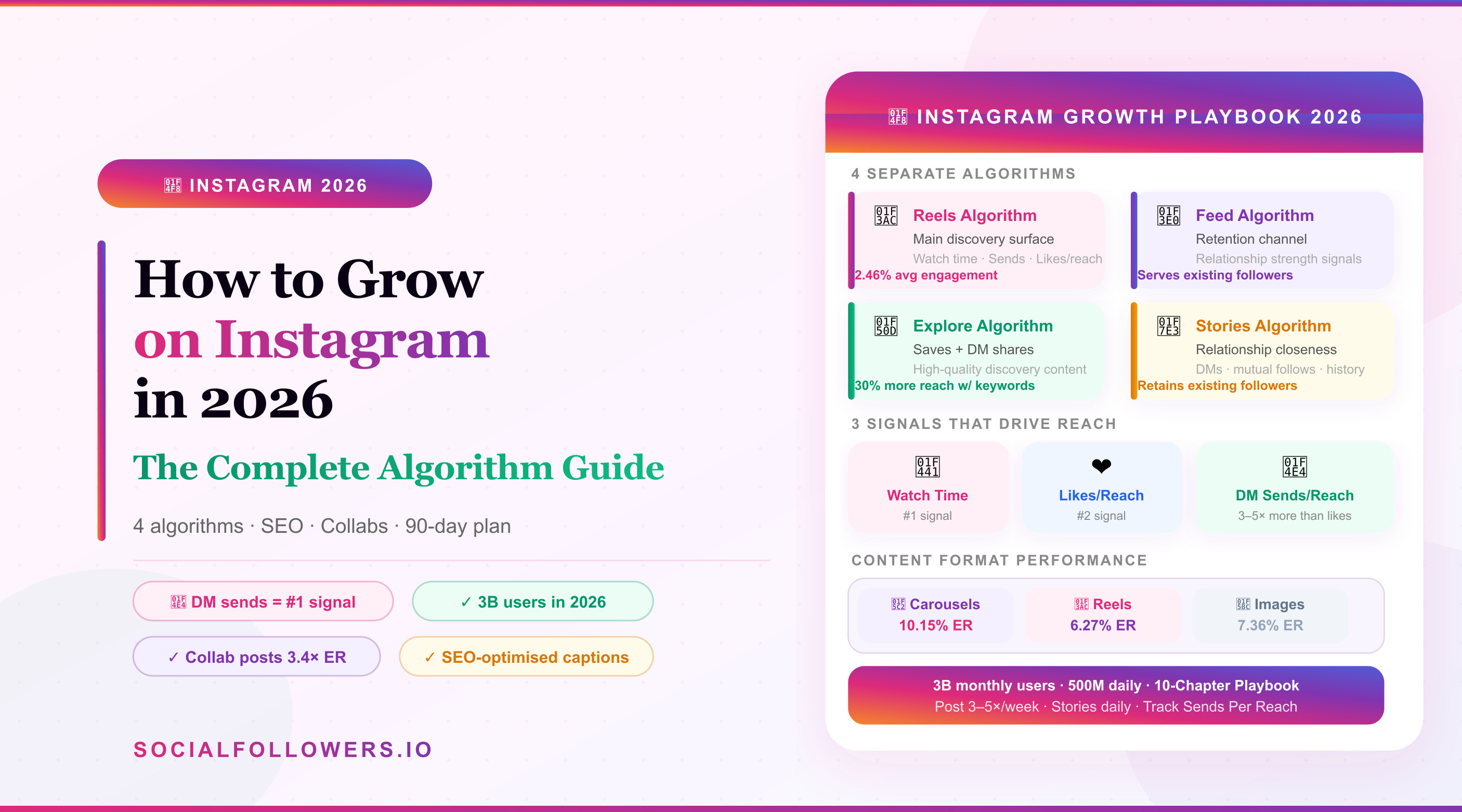
The platform has changed a lot in the last 18 months. Instagram now has four completely separate algorithms, one for each of its features: Feed, Reels, Stories, and Explore. Each one rewards different signals and needs different optimization strategies. Adam Mosseri, the head of the platform, said that DM shares are the most powerful signal for reaching new audiences. However, most creators are still not optimizing for them. Sending DMs is now 3 to 5 times more useful than likes for growing your audience.
In 2026, Instagram will have 3 billion active users every month, with almost 500 million using it every day. There is a huge chance. But the platform has also become a lot more competitive. In 2025, engagement rates across brand accounts dropped by about 24% year over year. The content feed is more full than ever, and the strategies that worked in 2023 have been replaced by a completely different algorithmic landscape.
This guide is based on what really works in 2026: the real algorithm mechanics, the content formats that get the most views, and the exact growth levers that are making a difference for accounts right now. No old advice. No old tricks. Just a real, full playbook with data to back it up.
Chapter 1: How Instagram Really Works in 2026
Most advice on how to grow your business sees Instagram as a single system with one set of rules. That's why a lot of advice doesn't work. Instagram has four different algorithms, each of which is designed to meet a different user need:
The Feed Algorithm shows you posts from accounts you follow, ranked by how relevant they are likely to be and how strong your relationship with them is. Key signals include how often you've interacted with the account in the past, how recently you've interacted with similar content, and how quickly the post got engagement in the first few hours. The Feed is not your discovery channel; it's your retention channel. It serves your existing followers.
The Reels Algorithm is the best way to grow your audience because it's the only place that consistently shows your content to people who have never heard of you before. It looks at your content's topic, watch time, and completion rate, then sends it to users who are likely to find it interesting (DM shares). In January 2025, Instagram CEO Adam Mosseri said that the Reels algorithm gives more weight to watch time, likes per reach, and sends per reach, in that order.
The Explore Algorithm shows users content that they are actively looking for new accounts and topics. It uses saves and DM shares a lot as signs of quality. When people who don't follow you save a lot of your content, it's a sign that it's worth referencing and that people want to come back to it. Explore sees this as high-quality discovery content.
The Stories Algorithm works based on how close relationships are, not how new they are. The algorithm shows stories in the order of how close it thinks you are to each account, based on DMs, mutual follows, past Story interactions, and engagement history. Stories don't directly help you get more followers, but they do keep the ones you already have. Accounts that post to Stories regularly get fewer unfollows.
Three signals now tell how far your content goes on all four surfaces:
Watch Time is the most important signal, especially for Reels. It doesn't just count how many people watched, but also how long they watched and if they watched it again. The algorithm sees more value in a 15-second Reel that people watch all the way through twice than in a 60-second Reel where 80% of viewers leave after five seconds. The algorithm sees early dropoff as a sign of poor quality and cuts back on distribution. In about 1.7 seconds, viewers decide whether to stay or scroll. That's why the hook is so important.
Likes Per Reach tells you how good your engagement is compared to how many people saw it. A post with 50 likes and 500 impressions (10% like rate) is better than a post with 200 likes and 10,000 impressions (2% like rate). This ratio metric gives points to accounts whose content really connects with the people who see it and takes points away from accounts that try to reach a lot of people at the cost of relevance.
The signal that most creators are ignoring and that matters most for discovery is Sends Per Reach, which is DM shares divided by reach. When someone sends your content to a friend through DM, they are doing it on purpose and with effort. They are telling someone they know about your content. Instagram sees this as the best sign of real value and responds by showing your content to more people who don't follow you. Sending direct messages (DMs) is three to five times more effective than getting likes for reaching new people. Make sure your content is "sendable" by design.
One of the biggest changes to algorithms in 2026 is what creators call the "aggregator penalty." Instagram now actively down-ranks accounts that repost content without adding a lot of new value. If you post videos from other accounts, repost viral clips, or post TikTok videos with watermarks, your content is being hidden. The platform's own rules say this. Not only is original content preferred, but it is also required by the algorithm.
This also means that you should export your content from source files, not from another platform with watermarks still on it. The algorithm finds watermarks and punishes people who share them.
Chapter 2: Optimizing Your Profile—The Key to Your Conversions
Your profile has to do the work before any of your content can turn viewers into followers. People often think of profile optimization as a one-time setup task, but it's really a conversion rate optimization problem: how do you get someone who is interested in your profile to follow you?
People usually take three to five seconds to decide whether to follow you after watching a Reel or being told about you by a friend. Your bio is the most important thing. There are four parts to an Instagram bio that gets a lot of clicks: What you do, in detail. Instead of "fitness content creator," say "3x/week home workouts for busy professionals." Instead of "business tips," say "Instagram growth strategies for service-based businesses." Being specific shows that you know what you're talking about and that the right people will see themselves in your description right away. Who you help. Be clear about who your target audience is. If someone reads your bio and thinks, "That's me," they will probably follow you. They don't follow if they're not sure they're the right audience. What they will get by following. This is what you have to offer. "Every Tuesday: one growth tactic, under 60 seconds." "Behind-the-scenes of building a 7-figure brand." Give them a specific, compelling reason to want more. A call to action. One thing to do. Not four choices, but one. Your link in bio, your lead magnet, a DM keyword, or a certain piece of content could be it. Direct, specific calls to action work; having too many choices makes things harder. Your username should be easy to remember and simple, and it should match or be very close to your handle on other sites. Make it easy to find and remember.
Most accounts waste their link in bio space on a homepage link or nothing at all. Use it wisely. You can use a Linktree, a Later link page, or Instagram's built-in link-in-bio tool to send people to more than one place, like your newest content, a lead magnet, a product, or a newsletter sign-up. Make sure to mention it directly in your content ("Link in bio for the full guide") and keep it up to date.
Instagram Story Highlights on your profile are like a carefully chosen preview of what your account has to offer. If someone is thinking about following you but isn't sure, tapping on your Highlights will give them a quick look at what you have to offer. Instead of using your personal archives, build Highlights around your content pillars. "Tutorials," "Quick Tips," "Behind the Scenes," "Client Results," and "FAQs" are all for new visitors, not for your current followers. Make sure they all look the same, update them often, and put your best content first.
For personal brands, your profile picture should be a clear, easy-to-see picture of your face. For business accounts, it should be a picture of your logo. It shows up as a thumbnail on the whole platform, so make it stand out and match how you look everywhere else. Your grid is the first thing people see that shows them what your content looks like when it's big. A consistent visual style, color palette, or format that people can recognize right away helps people remember your brand. Before they even read a caption, visitors make decisions about how professional and consistent you are based on the grid. This doesn't need a strict style; it needs a clear visual direction.
Chapter 3: The Content Strategy That Will Really Grow Accounts in 2026
In 2026, reels are still the best way for accounts of all sizes to get more followers naturally. The 2025 Content Benchmarks Report from Sprout Social says that Reels have a 2.46% engagement rate and are the only type of content that is consistently shown to non-followers at scale. Reels get a lot more views than any other format for accounts with less than 50,000 followers. This is where small accounts have a structural advantage.
Three things that Reels must have to grow accounts: A hook that works in 1.7 seconds. The algorithm keeps track of how quickly viewers leave, and they do so almost right away. Your first image and text must make people want to know more right away, break up the pattern, or promise value. Don't start with a logo, a greeting, or a description of the scene. Drop into the part of the video that is the most interesting. Reels with a strong hook or jump cut in the first three seconds are 72% more likely to go viral than those without one. More than 50% of people finished. This is the main thing you want to improve. Ask yourself, "Would someone watch this all the way through?" If the answer is "maybe" or "it depends on how interested they are in this topic," your Reel needs a better opening and tighter editing. Jump cuts every 3 to 5 seconds boost completion rates by an average of 32%. Get rid of every second that doesn't deserve it. Value that is worth sharing on DM. Ask yourself, "Would someone send this to a friend?" after you make a Reel. If not, why not? People share content through DM if it is useful enough that someone wants to help a friend with it, emotionally resonant enough to feel like a personal recommendation, or funny enough to be a gift. Make it easy to share—it's the best way to get people to see your content on the platform.
The best length for a reel in 2026 is between 60 and 90 seconds, according to benchmark data. However, 15 to 30 seconds works very well for content that is meant to be discovered. Don't pick a length based on what you think Instagram wants. Instead, pick the shortest length that gets your point across without adding extra words. Every time, a tight 35-second Reel with a 75% completion rate beats a padded 90-second Reel with a 30% completion rate.
Try out Trial Reels. With Instagram's Trial Reels feature, you can test new content with people who don't follow you without changing the feed of the people who do follow you. Before you use them as part of your main growth strategy, use this to A/B test different hooks, styles of content, and lengths.
Carousels are better at getting people to interact with them than Reels, even though Reels are better at reaching more people. Metricool looked at millions of posts and found that carousel posts get 10.15% engagement, which is more than standalone Reels (6.27%) or image posts (7.36%). A different three-year Buffer study found that carousels get 12% more total interactions than Reels and 2.14 times more engagement than single-image posts.
Carousels also have the highest save rate of any type of content, at 3.4%. Saves are one of the most important algorithmic signals for Feed and Explore distribution. Carousels also have a special algorithmic advantage: they get a "second chance." If someone scrolls past your carousel without clicking on it, Instagram may show it again later, starting with slide two. This gives carousel content more chances to get noticed, which greatly increases the number of impressions.
What makes carousels work: The first slide should work like a Reel hook; it's what makes people stop scrolling. A bold statement, an unexpected statistic, a thought-provoking question, or a strong visual contrast. Nothing else matters if slide one doesn't get the swipe. Each slide after the first should only have one point or piece of value. One point for each frame. This keeps the viewer interested and gives the algorithm more swipes to count as positive signals. "Save this for later" is always a better call to action for carousels than "Like if you agree," "Tag someone," or "Comment below." People save things they plan to use, so carousel content that is educational and useful will naturally get saves. The best length for a carousel is 6 to 10 slides, which gives the best balance of depth and completion. Research shows that the highest reach happens around slide 13 for longer sequences. However, completion rates drop sharply after 10 slides unless each frame earns the next swipe.
When you make a Collab Post with another account, the content shows up on both profiles at the same time and gets attention from both audiences. The first wave of engagement from two groups at once sends a strong quality signal to the algorithm. Collaborative posts get 3.4 times more engagement than regular posts, and posts with 4–5 collaborators get 3.8 times more reach than regular posts. This is one of the platform's least used tools for growth.
Stories don't help you get more followers, but they do help you keep the ones you already have. People who post to Stories regularly see fewer people unfollow them over time. This is because Stories keep the relationship going with current followers, which keeps them interested in your account. Reels bring new followers in the front door, and Stories keep old followers from leaving through the back door.
The goal is to write stories every day. You don't need a lot of fancy production for this. Behind-the-scenes moments, polls, questions, quick thoughts, and previews of content all work. Polls, question stickers, and slider reactions are all examples of interactive elements that get people to pay attention to your Stories and move them to the front of their queues. Stories are also a good way to get your main feed content ready. If you tease a new Reel or carousel in Stories before you post it, you'll get a lot of engagement right away from people who saw the teaser. This early engagement tells the algorithm that your content is worth showing to more people. Accounts with fewer than 10,000 followers: Data from 2025 to 2026 shows that accounts with fewer than 10,000 followers are seeing a 35% increase in Story reach rates. This means that Stories are doing better than expected for smaller accounts. Now is the time to start making Stories a habit.
For three years in a row, static single-image posts have been on the decline. In 2025, engagement rates on images dropped 17% from the previous year, and brand accounts have been posting fewer single images as marketers switch to formats that work better. Instagram's algorithm also shows images to non-followers much less often than Reels. That being said, pictures still have a place. High-quality single images are great for announcements, quote posts, brand moments, and content that focuses on photography. When used between higher-effort content formats, they also help keep your grid moving at a good pace. It's wrong to use single images as your default format just because they're the easiest to make. Instead, pick a format based on what your content idea needs, not how easy it is to make.
Chapter 4: Instagram SEO: The Growth Lever That Most Accounts Don't Use
Instagram's biggest change is that it has become a real search and discovery platform. Google has been indexing public Instagram content since July 2025. This means that your posts can show up in Google search results, not just in Instagram's own search. This gives keyword-optimized content a growing SEO edge that most Instagram creators haven't figured out yet.
Keyword-rich captions now get about 30% more reach on Instagram than hashtag-heavy captions. The platform's AI reads and sorts the text in your captions, on-screen text, and even your spoken audio. It then uses that semantic understanding to match your content to the right people.
Include your niche keywords in your bio in a way that sounds natural. "Plant-based recipes | food photographer | sustainable living" is easier to find than "living my best life ✨." Instagram's search algorithm uses bio text as a main way to sort users. Write captions that naturally include the words that people in your target audience would look for. Instead of saying, "I'm so excited about this," say, "Here's a 20-minute home workout for beginners that doesn't need any equipment." The second version gives the algorithm clear, useful information about what your content is about. Alt text: Instagram lets you write your own alt text when you post something. This is a description of the image that was originally meant to make it easier to find but now works as a search indexing signal. For each post, write alt text that is full of keywords and describes the post. Text on screen in Reels: Instagram's visual AI uses optical character recognition (OCR) to read text and captions on the screen. Putting your main keyword, "Home workout for beginners," at the beginning of your on-screen text helps the algorithm sort your content and show it to the right people. Account name and username field: The field for your account name (which is different from your username) can be searched. If you want to show up in search results for your niche, use keywords that are relevant, like "Sarah | Instagram Growth Coach" or "Marco | Plant-Based Chef."
The way people use hashtags has changed a lot. In December 2024, Instagram took away the ability to follow hashtags. Since then, the app has been warning users when they use too many hashtags. There is no longer a need for 20 to 30 hashtags in every post. The best way to do things right now is to use 3–5 highly targeted hashtags that are relevant and have the right level of competition. Don't think of hashtags as a way for people to find your content; instead, think of them as labels that help the algorithm understand what you're talking about. Now, keywords in captions do the work of finding things, not stacking hashtags. Use a mix of one broad category hashtag and niche-specific hashtags that are related to the exact topic of your content. If you're posting a workout for beginners to do at home, good hashtags to use are #homeWorkout, #beginnerFitness, and a couple of more specific ones. Five carefully chosen hashtags always do better than thirty random ones.
Chapter 5: Engagement Strategy—How to Get Bigger by Being There
The algorithm's main evaluation window is the first hour after posting. The early engagement velocity, or how many times people interact with your post in the first few minutes after it goes live, is a good way to tell how widely the algorithm shares your content. You can have a big impact on this by acting in a certain way before and after you post. Use Stories to tease the content you are about to post. Tell your current followers, "New Reel dropping in 10 minutes." Even a small increase in the speed at which followers who were ready to watch engage with the content sends a stronger quality signal to the algorithm. After you post, spend 15 to 30 minutes actively interacting with other accounts in your niche. Like, comment on, and respond to posts from accounts that your target audience follows. This action makes you more visible to accounts that are relevant to you and their followers. It also tells the algorithm that you are an active and engaged member of your content community. Answer every comment. Later's 2026 engagement research found that accounts that respond to more than 50% of comments in the first hour get 23% more engagement on future posts. Every time you reply to a comment, it adds to the conversation thread, keeps people on your post longer, and sends a notification that brings the commenter back. All of these tell the algorithm how good the signal is.
Most tips for growing your Instagram account only talk about your own posts. Some of the fastest-growing accounts, on the other hand, get a lot of new followers by strategically interacting with other accounts, like by being the best commenter in their niche. When you leave a meaningful, well-thought-out comment on a post from a larger account in your niche, three things happen: the creator sees your comment and often visits your profile; other followers of that account see your comment and sometimes visit your profile; and the algorithm sees your engagement activity as a sign that your account is relevant to the topic. The most important word is real. "Great post!" doesn't add anything and is ignored. "This is exactly what I found when I tested [specific thing]. The only difference was [specific insight]." This adds real value and starts a real conversation. The more detailed and useful your comments are, the more likely they are to get people to visit your profile. Find accounts in your niche that are one to two levels bigger than you. They should be big enough to have a big impact but small enough that the creator still reads and responds to comments.
Direct messages are the most personal way to connect on Instagram, and in 2026, DM sends are the most important signal for the algorithm. Make a plan that takes both sides into account: Ask your audience to send you DMs. "DM me your question" or "Reply to this with your biggest challenge" are examples of Stories CTAs. Answer every DM personally. Each DM conversation not only adds value to the relationship, but it also strengthens the algorithmic relationship signal between your account and that follower. This means that they are more likely to see your future posts. The automated comment-to-DM strategy. You can set up keyword-triggered DM automations on Instagram using its built-in tools or third-party tools like ManyChat. For example, you could say, "Comment [keyword] and I'll send you [resource]." This will get people to comment more (a good sign), start direct DM threads (the platform's most valuable sign), and give your audience real value at the same time. This one strategy always leads to huge growth for accounts that use it the right way.
Chapter 6: Working Together and Strategies for Cross-Growth
With Instagram's Collab Post feature, up to five people can work together on a single post. The content will show up on all of the collaborators' profiles at the same time. When you publish a Collab Post with another account, it instantly reaches two (or more) different groups of followers, getting people to interact with it right away from all of them. The algorithm sees that a lot of people are interested in the content right away, and it pushes it further into Explore and Reels recommendations. This is why Collab Posts get 3.4 times more engagement than regular solo posts on average. The psychology is just as strong. People trust a new account more when they see that a creator they already trust is working with it. Collab Posts are one of the best ways to get new followers because of this "transfer of trust." The new follower is already pre-qualified by an account they trust. How to find people to work with: Look for accounts in niches that are close to but not competing with yours and have audiences that are similar to yours. A nutrition and fitness account. A brand of travel gear and a travel photographer. A coach for businesses and a maker of tools to help people get things done. Your new followers come from the overlap of your audiences. The cleaner the overlap, the higher the conversion rate. Joint tutorials or how-to content, behind-the-scenes looks at a collaboration or project, joint giveaways with prizes that are relevant to both audiences, and co-created carousel series are all examples of types of collabs that work. Always make sure that both audiences will really benefit from the content. Forced collaborations feel forced and don't work well.
Instagram Lives that are done together with accounts in your niche or a related niche let both accounts' audiences see each other in real time. Lives also get better placement in Stories feeds; Instagram puts them at the front of the line so that both accounts' current followers can see them the most. Joint Lives are most effective when they are set up like real conversations, interviews, or Q&A sessions instead of appearances to promote something. Viewers from both groups are more likely to follow both creators if the conversation is interesting and valuable.
Tagging other accounts in your Stories and Reels, as well as being tagged by others, makes both accounts more visible and encourages both accounts to interact with each other. Your best mention targets are accounts whose followers would really benefit from knowing about you. Don't go after tags from the biggest accounts in your niche. Instead, go after accounts whose audiences are a good fit for your content.
Chapter 7: Getting the Most Out of Instagram's Features
General guidelines say that the best times to post are between 7 and 9 AM and 11 AM and 1 PM in your audience's time zone. Tuesday through Thursday usually has more engagement than weekends. But these are not prescriptions; they are averages for the whole population. Instagram Insights has the best time for you to post. Go to "Audience" and then "Most Active Times." Check this once a week and plan your posts around when your specific followers are online. A US-based account with mostly Australian followers needs a posting schedule that is very different from what the generic benchmarks say. More important than posting at the right time is posting often enough that the algorithm trusts your account. An account that posts reliably three times a week, even if the times aren't always perfect, is better than one that sometimes posts at the perfect time but doesn't always do so.
Instagram's algorithm actively favors content that uses new features on the platform. This is true for every major update to the platform and is Instagram's way of encouraging creators to use new tools. When Instagram adds a new sticker, Reel format, interactive feature, or creation tool, people who use it first get more exposure. Follow Adam Mosseri's and Instagram's official @creators account to find out about new features. Try out new features during the launch week, when the algorithm is most likely to favor them.
Instagram isn't a stand-alone site. Getting traffic from outside sources greatly increases the number of followers who convert from your current audiences: Email newsletters: Include your most recent post or Reel in your newsletter and link to your profile. People who find you on Instagram and then sign up for your email list are usually very interested in your content. You can also share your Reels on YouTube Shorts, LinkedIn, Pinterest, or TikTok (without watermarks). Even a small amount of cross-platform distribution can bring a lot of traffic to your profile from people you've already built an audience with. Add Instagram Reels and carousels to relevant blog posts on your website or blog. Embedded Instagram content on indexed web pages brings in organic traffic from both your current visitors and people who find your site through search engines.
Chapter 8: Posting Frequency and Content Pillars
The accounts that grow the fastest aren't the ones that post the most; they're the ones that post the most coherent content. When every post fits into a clearly defined topic framework, the algorithm puts your account in the right category, shows your content to the right people all the time, and followers know exactly what they're getting into. Pick three to five content pillars that together show what your account is about. For a social media consultant, these could be: ways to grow your Instagram account, systems for making content, how to read analytics, case studies, and how to build your own brand. Every post is connected to one pillar. No randomness, no disconnection. This coherence is important for Instagram's algorithms because they use the history of your posts to figure out what your account is about. The algorithm sorts your content more accurately and matches your Reels and posts to people who are interested in that topic the more often you post about it. The algorithm can put niche accounts in the right place more easily, which is why they grow faster than generalist accounts.
Buffer looked at more than two million Instagram posts and found that accounts that post three to five times a week get twice as many followers as accounts that post once or twice a week. The right amount of frequency is enough to keep the algorithm going and reach the same audience over and over again, but not so much that the quality goes down, which is what the algorithm rewards. For feed posts like Reels, carousels, and pictures, 3 to 5 times a week. For Stories: Every day (5 to 7 times a day is best). For Lives: once or twice a month, or once a week if you can keep up the quality. The most important part of all of this is "without sacrificing quality." A great Reel three times a week always beats a mediocre Reel every day. The algorithm's shift toward watch time and sends means that content that gets people to engage with it does better than content that gets a lot of views but not much engagement.
Chapter 9: Real Growth Metrics
The number of followers is the least useful way to tell if your Instagram strategy is working. These are the numbers that really count:
The follower growth rate is the percentage change from month to month, not the raw number. Small accounts with 1,000 to 5,000 followers are growing at an average rate of 38%, which is better than mid-size accounts with 10,000 to 50,000 followers, which are growing at an average rate of 33.8%. Don't count your rate; keep track of it. Sends Per Reach is the number of people who saw your content and shared it through DM. This is the most important signal and the best way to tell if you're making content that people will really want to share. You can find this in Instagram Insights under each post's metrics. 3-Second Hold Rate (for Reels): This tells you how many people watched the video for more than three seconds. A hook that gets algorithmic amplification has a strong score of over 60%. If the number is below 40%, it means the algorithm is getting a bad quality signal and cutting back on distribution. Save Rate = the number of saves divided by the number of people reached. Content that gets a lot of saves is content that people want to come back to. Explore page distribution is directly related to strong save rates. Follows per 1,000 views (Reels) is the real conversion rate for you. This tells you how well your Reels are turning viewers into followers. If your FPV is low, it means that your content is getting seen but not converting. This usually means that your content doesn't have a strong identity, your bio isn't clear, or you don't have a clear follow CTA. Profile Visits to Follow Ratio: This tells you how many people who look at your profile end up following you. If your conversion rate is low, it means that your profile isn't doing a good job of convincing people to follow you. Check your bio, highlights, and grid cohesion again.
Take 30 minutes every Monday (or at the start of each week) to look over how well your content did the week before. Which post got the most Sends? Answer these questions. Which one had the best 3-second hold rate? What drove the most visits to profiles? Which one got the most follows? What sets the best performers apart? Write down the patterns. You'll have enough data to figure out what's working for your account and your audience in three to four weeks. Then you can go all in with confidence.
Chapter 10: What Doesn't Work in 2026
Some methods look like shortcuts, but they always hurt long-term growth:
Getting followers by paying for them. Instagram's algorithm divides the number of people who interact with your posts by the number of followers you have. Fake followers make the denominator bigger without adding engagement, which lowers your engagement rate and tells the algorithm that your content isn't connecting. This actively lowers your organic reach. In addition to the damage done by algorithms, brands and potential partners now regularly check the quality of their followers before working together. It's easy to spot bought followers. Tactics for following and unfollowing. This strategy gets accounts to follow you back, but not because they are really interested in you. Those followers don't interact. Their presence hurts your rate of engagement. And Instagram's spam detection systems are getting better at spotting aggressive follow/unfollow behavior. Automation and comments that are the same. Instagram's spam filters catch and punish people who leave "Amazing post! 🔥🔥" on hundreds of accounts. It also has a conversion rate of zero, which means that no one follows an account because of a generic comment. Posting without a clear niche. The algorithm can't put your account in the right category if the content is random and doesn't connect. The result is inconsistent, low-quality reach: your content is shown to people who aren't interested in it, which leads to low engagement rates, which tells the algorithm that your content isn't resonating. This cycle keeps going and is hard to break without a big change in strategy. Not paying attention to your analytics. Posting without knowing what's working is "like driving with your eyes closed," according to the data. Each post you make is a piece of data. Every piece of data you don't look at is a chance to learn that you miss.
Here are the steps to follow for 90 days to put everything in this guide into action:
Days 1 to 14: Building Blocks. Check and improve your profile (bio, highlights, link in bio, profile picture, and grid). Clearly define your three to five main content areas. Set up Instagram Insights and write down your starting numbers. Use strong hooks to post your first three Reels. Post to Stories every day.
Days 15–30: Stay the same. Set a schedule for your 3 to 5 posts each week. Get into the habit of reviewing your analytics every week. Every day, leave five meaningful comments in your niche. Find three to five possible collab accounts and contact two of them. Use keywords instead of stacks of hashtags to improve your captions.
Days 31–60: Growth. Start your first Collab Post. Try out the comment-to-DM automation plan with one piece of lead magnet content. Look at your three best Reels and see what they all had in common. Do more of that. Check your bio and make changes based on what you now know works. Start trying out Trial Reels for new types of content.
Days 61 to 90: Scale. With a partner account, you can run a joint Live or collaborative Reel. Set up a simple system for cross-promotion with two or three other creators who work in similar areas. Look at your content pillars again after 60 days of data. Are they still correct? What do your readers really respond to the most? Make your best-performing content formats into series that keep going. After 90 days, you'll have enough information to know what works for your account and a solid, tested base to build on.
It is harder to grow on Instagram in 2026 than it was in 2020 or 2021. The platform has more users. Engagement rates have gone down for almost all types of accounts. There has never been more competition for attention.
But the chance is also bigger. There are three billion users every month. A platform that is always improving its discovery tools, like Reels, Explore, social SEO, and shopping links. A brand preference among the most important groups of customers. There is a gap between brands that know how to use the 2026 algorithm and those that are still using 2022 strategies. You can take advantage of this gap with the information in this guide.
The accounts that are growing steadily right now have a few things in common: they make content that people want to share (not just watch), they show up regularly and not randomly, they use their analytics as feedback instead of scorecards, and they build real communities instead of just trying to get more followers.
None of that is hard. You need to be disciplined for all of it.
We help creators and brands get real, engaged, and strategically valuable Instagram followers at SocialFollowers.io. These are the kinds of followers that help with monetization, brand deals, and business growth. We are the growth partner that makes the strategy work, whether you are starting from scratch or breaking through a plateau.