Top 10 Social Media Mistakes Brands Make (And How to Avoid Them)
In 2026, there are two kinds of brands on social media: those growing through genuine engagement, and those posting regularly while wondering why nothing is working. The gap between them is rarely about budget, talent, or content quality. Most of the time it comes down to a handful of avoidable mistakes that quietly undermine everything else a brand is doing right. With 5.4 billion social media users spending an average of 2 hours 21 minutes per day on these platforms, the opportunity has never been bigger — but the competition for attention has never been fiercer. Mistakes cost more now than they ever have. This guide covers the ten most common and most damaging social media mistakes brands make in 2026, with specific, actionable fixes for each one.
Mistake #1: Using Social Media as a Broadcasting Channel
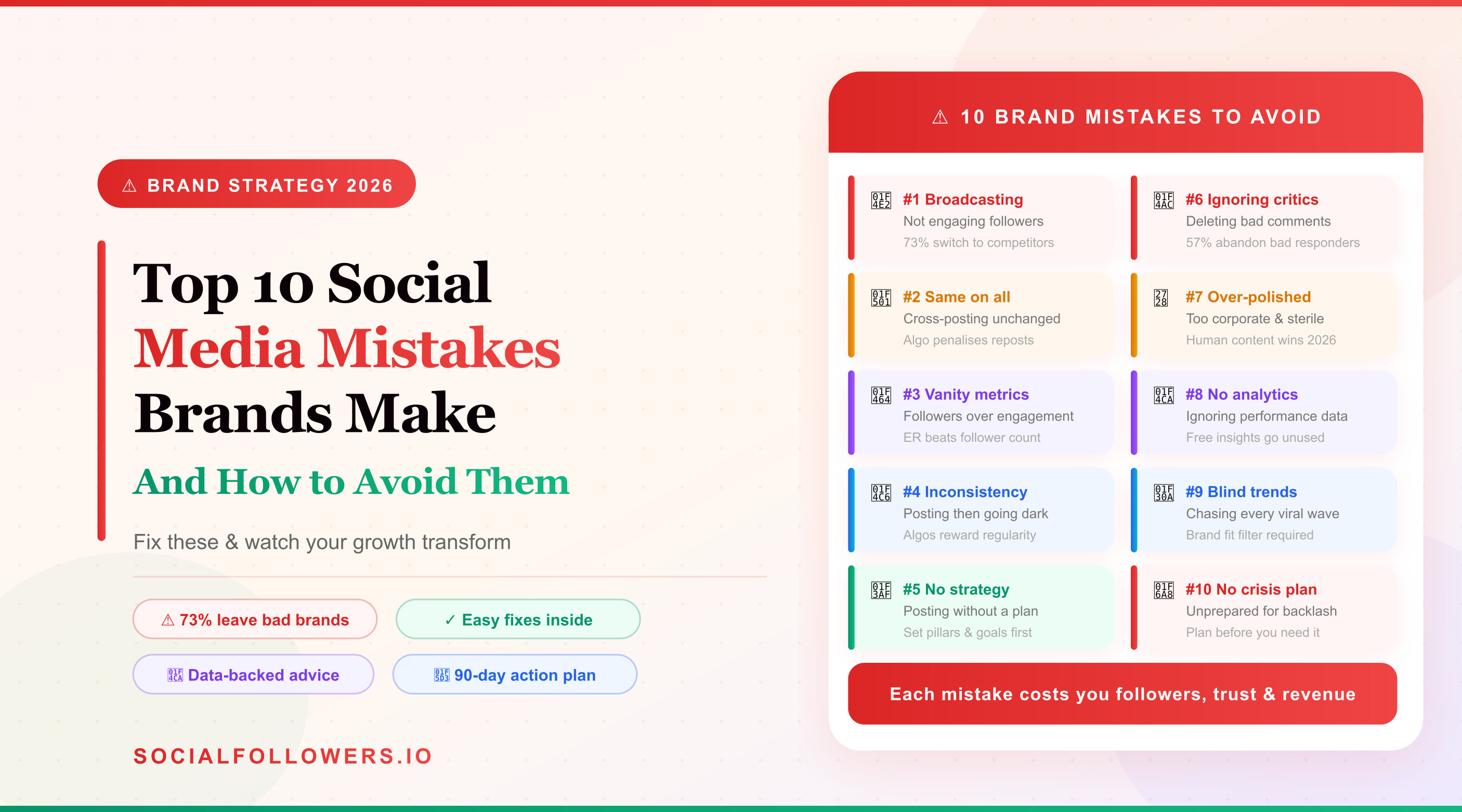
This is the single biggest mistake brands make, and it silently undermines every other part of their social strategy. The broadcast mindset treats social media like a press release channel: publish content, move on, ignore the comment section. In 2026, this approach is a direct path to irrelevance. Research is clear: 73% of social media users say that if a brand doesn't respond to them, they'll buy from a competitor. 80% expect a response to comments and messages within 24 hours. 50% say they would stop doing business with a brand that doesn't respond to negative feedback at all. The brands that perform best on social media treat the comment section as a community to build, not a thread to manage. The fix is a mindset shift: every post is the start of a conversation. Assign response ownership, set response time targets (under two hours for DMs, same day for comments), and go proactive — leave thoughtful comments in your niche, join relevant conversations, and let your followers feel the real presence of a person behind the account.
Mistake #2: Copy-Pasting the Same Content Across All Platforms
Cross-posting identical content across every platform — same caption, same image, same hashtags — is one of the most common time-savers that silently damages brand performance everywhere. Every platform has a distinct personality, cultural norms, and audience expectations. What earns strong engagement on TikTok (raw, fast-paced, trend-driven) can look jarringly out of place on LinkedIn (professional insight, thought leadership). What reads well on Instagram (visual, aspirational, save-worthy) falls flat on X (brief, sharp, real-time commentary). Worse, there's an algorithmic penalty: Instagram actively suppresses content bearing a TikTok watermark, and TikTok identifies recycled content and limits its reach. The fix isn't creating entirely new content for every platform from scratch — it's being smart about adaptation. Keep the core idea, but adjust the language, format, length, and creative style to fit each platform's native culture. Repurpose intelligently, not lazily.
Mistake #3: Prioritising Follower Count Over Engagement Quality
Follower count is the most visible metric on any social profile, and it's also one of the least meaningful for measuring real business impact. A brand with 50,000 followers and a 5% engagement rate is exponentially more valuable than one with 500,000 followers and 0.3% engagement — in terms of algorithmic distribution, audience trust, and actual conversion potential. Brands that chase follower numbers through follow-for-follow tactics, off-brand giveaways, or purchased followers end up with hollow audiences: accounts that followed for a prize, never engaged, and tank algorithmic performance by signalling that content isn't resonating. The influencer marketing industry has already made this shift — 73% of brands now prefer micro and mid-tier creators over macro-influencers specifically because smaller, more engaged audiences deliver better real results. Stop using follower count as your primary KPI. Track engagement rate, saves, shares, and conversion metrics instead, and build content that genuinely serves your current audience.
Mistake #4: Posting Inconsistently and Over-Extending to Too Many Platforms
Inconsistency is one of the most algorithmically damaging patterns a social account can exhibit. When a brand posts intensively for two weeks, then goes silent for a month, then surges again, every algorithm it touches learns to stop distributing its content — because the account isn't reliable. Algorithms on Instagram, TikTok, LinkedIn, and YouTube all reward consistent, regular posting because it signals reliability to both the platform and its users. The credibility damage extends beyond algorithms: an account with a last post dated 47 days ago doesn't look "busy" — it looks abandoned. The adjacent mistake is spreading across too many platforms simultaneously: attempting to maintain active, quality presences on TikTok, Instagram, LinkedIn, Facebook, YouTube, X, and Pinterest at the same time almost always results in weak content and poor engagement on all of them. The fix: choose a sustainable posting frequency and stick to it, even on your slowest weeks. Focus on one or two platforms where your audience is most concentrated. Use scheduling tools like Buffer, Hootsuite, or Later to maintain a two-week content buffer.
Mistake #5: Posting Without a Strategy or Clear Goals
Posting regularly without a strategy is not social media marketing — it's expensive noise. Many brands are on social media with no clearer plan than "post things and see what sticks," resulting in feeds that look active but don't produce any measurable business outcome. Before creating another piece of content, define four things: who specifically your audience is on each platform (not broad demographics, but a precise, specific person with specific needs and behaviours); what three to five content pillars your brand consistently covers; what success looks like with actual numbers and deadlines ("raise Instagram engagement from 1.2% to 3% in 90 days," not "grow our presence"); and which business objective each social channel is serving — brand awareness, lead generation, community, sales, or retention. Every post should serve a pillar, serve an audience need, and move toward a measurable goal. That's the difference between a brand that posts and a brand that grows.
Mistake #6: Ignoring or Mishandling Negative Comments
How a brand handles criticism on social media is one of the most publicly visible tests of its character — and it's one every brand will face repeatedly. The wrong responses are well-documented: deleting genuine negative comments, responding defensively, copy-pasting corporate non-answers, or ignoring the criticism entirely. All of these options make the brand look like it doesn't care, and the consequences are significant: 57% of consumers have stopped buying from a brand because of a poor digital customer service experience, and nearly half say they'd stop doing business with a brand that doesn't respond to a negative review. But the opposite is equally true: a brand that responds to a complaint with genuine empathy, a practical solution, and follow-through often earns more trust from the observers than it loses from the initial complaint. Establish a clear protocol before criticism arrives: set a response time target, define tone guidelines (calm, specific, empathetic — never defensive or dismissive), create escalation paths for complex issues, and never delete legitimate negative feedback.
Mistake #7: Over-Polished, Corporate-Looking Content
A growing body of data points to a clear shift in what social media audiences respond to — and many brands are moving in the wrong direction. Highly polished, glossy, heavily branded content is consistently being outperformed by raw, human, authentic content from creators who understand the medium in 2026. Audiences in 2026 don't want to engage with a brand's marketing department — they want to connect with real people, real stories, and real moments. Nearly a third of consumers say they are less likely to choose a brand that uses AI-generated ads, and the "too perfect" aesthetic registers as corporate insincerity to most social media users who have developed finely tuned filters for it. This doesn't mean abandoning quality — it means understanding the difference between sterile corporate perfection and genuine, thoughtful content. A Reel shot on a smartphone that shows real people doing real things will almost always outperform an expensive studio production. Put people on camera. Show how your products are made. Share behind-the-scenes moments. Let the human imperfections stay in.
Mistake #8: Ignoring Analytics and Performance Data
Many brands treat social media as a creative exercise rather than a performance channel — they publish content, move on, and never examine what actually happened. This is the equivalent of running a direct mail campaign and never checking open rates, click-throughs, or conversions. Every major social platform provides detailed, free analytics: Instagram Insights, TikTok Analytics, LinkedIn Analytics, and Meta Business Suite all show exact reach, impressions, engagement rate, saves, shares, profile visits, link clicks, follower demographics, and optimal posting windows. Ignoring this information isn't a missed opportunity — in a competitive market, it's a choice to operate blindly while competitors improve with every post. Make a weekly analytics review a fixed part of your workflow. Ask: what performed best and why? What flopped and what does it tell you? What format consistently outperforms? Which content topics drive the most saves? Use those answers to improve the next piece of content. Every post becomes data, and data-driven social media compounds over time.
Mistake #9: Chasing Every Trend Without Considering Brand Fit
Trend-chasing is one of the most tempting and most frequently regretted decisions in social media management. A sound on TikTok goes viral. A meme format sweeps Instagram. Brands that want to capture the reach jump in immediately — even when the trend has nothing to do with their product, audience, or identity. The results are often visible evidence of a brand trying and failing to participate in a culture it doesn't understand: a B2B software company posting a Gen Z meme, a luxury brand doing a cringe-worthy dance trend, a bank lip-syncing to a breakup song. These moments don't make brands seem relatable — they signal cultural cluelessness, which is worse. Beyond the awkwardness, there's a strategic cost: constantly chasing trends at the expense of consistent brand identity confuses your audience and weakens your brand signal over time. The fix is a simple three-question filter before participating in any trend: Does it fit our brand voice and identity? Is our audience genuinely interested in it? Can we execute it well quickly enough to arrive early rather than late? All three yes — proceed. Any no — skip without regret, and invest that energy into building original content series that your audience will associate exclusively with you.
Mistake #10: Having No Crisis Management Plan
No brand plans for a social media crisis — and most aren't ready when one arrives. But crises are not a matter of if: a product recall, an employee posting inappropriately on the brand account, a campaign misfire that goes viral for the wrong reasons, a customer complaint that escalates. In 2026's always-on media environment, a post can go from 50 to 5 million views within 24 hours and become a national news story. Brands that haven't prepared respond inconsistently, reactively, and often make manageable situations far worse. Build your crisis plan now, before you need it. It should include: a clear internal response protocol mapping exactly who is notified and who approves external communications; pre-approved response frameworks for common crisis types (product issues, cultural missteps, staff incidents) as starting points; a social listening monitoring system (Sprout Social, Brandwatch, or Hootsuite) so you see conversations as they develop, not hours later; and a "pause and assess" protocol — 30–60 minutes to understand the full picture before making any public statement. Quick is important; correct is more important. Then conduct an internal review after every crisis and improve the protocol each time.
All ten of these mistakes share the same underlying cause: treating social media as an outbound marketing channel rather than a relationship-building platform. The broadcast mindset, the copy-paste cross-posting, the obsession with vanity metrics, the inconsistency, the strategy-free posting, the mishandled criticism, the corporate polish, the avoidance of analytics, the blind trend-chasing, and the lack of a crisis plan — every one of them comes from a brand that sees social media as a way to transmit messages, not create connections. The brands winning in 2026 made a different choice. They show up consistently. They listen and respond at the same rate they publish. They adapt to each platform's culture rather than fighting it. They track what matters. They see their audience as an asset worth protecting. And they earn trust one post and one reply at a time. That's not a complicated formula — but it requires discipline, and it requires stopping the habits that cost results before you even realise it. At SocialFollowers.io, we help brands and creators build social media presences that generate real engagement, real audience growth, and real business impact.